Showing posts with label ResearchScientist. Show all posts

Tuesday, April 8, 2025

Prof. Dr I-Shyan Hwang Yuan, Ze University, Taiwan, Best Researcher Award #ScienceFather #Researcher #ResearchScientist #NetworkAwards #ResearchAwards #NetworkingEvent


Prof. Dr I-Shyan Hwang Yuan, Ze University, Taiwan, He is from Taiwan, He won the Best Researcher Award in the event of Global Network & Technology Excellence Awards by ScienceFather.

Best wishes for your future by ScienceFather


See more Info : network.sciencefather.com

Nomination: https://networking-events.sciencefather.com/award-nomination/?ecategory=Awards&rcategory=Awardee


Social Media :

Instagram
Pinterest
Youtube
Facebook
Linked in


#ScienceFather #Researcher #ResearchScientist #Speaker #AI #Networking #NetworkAwards #ResearchAwards #NetworkingEvent #Innovation #NetworkTechnology #BestResearcherAward #AI #5G #IoT #Cybersecurity #CloudComputing #DigitalTransformation #Blockchain #EdgeComputing #SmartCities #BigData #QuantumComputing #BigData #SmartCities #Blockchain #Automation #Industry40 #AR #VR #GreenTech 


Thursday, March 27, 2025

Mr. Huang hongzhou, China University of Geosciences, China, Best Researcher Award #ScienceFather #Researcher #ResearchScientist #NetworkAwards #ResearchAwards #NetworkingEvent


Mr. Huang Hongzhou, China University of Geosciences, He is from China, He won the Best Researcher Award in the event of Global Network & Technology Excellence Awards by ScienceFather.

Dr. Huang Hongzhou is a Ph.D. student in Mechanical Engineering at the China University of Geosciences, Beijing, where he focuses on the structural and thermal design of satellites, emphasizing lightweighting and optimization techniques. 

He previously earned his postgraduate degree in Mechanical Engineering from the same institution, concentrating on the dynamics of space robot arms and the vibration of satellite solar wings due to thermal deformation. With extensive experience as a Satellite Structural Design Engineer at Beijing JTSAPCE Technology Co., Ltd., Dr. Huang contributed to the successful structural and thermal design of four satellites that operated effectively in space. 

He has published several research papers in reputable journals, addressing dynamics modeling and simulation in space mechanisms and thermal design innovations. His work exemplifies a strong commitment to advancing satellite technology through innovative engineering solutions.

Huang Hongzhou’s combination of rigorous academic training, significant professional achievements, and impactful research contributions make him a highly deserving candidate for the Research for Best Researcher Award. His work not only addresses critical challenges in satellite engineering but also has the potential to drive innovation in the broader field of aerospace technology. Recognizing him with this award would not only honor his achievements but also encourage further advancements in mechanical engineering and satellite design.

Best wishes for your future by ScienceFather


See more Info :  network.sciencefather.com


Social Media :


#ScienceFather #Researcher #ResearchScientist #Speaker #AI #Networking #NetworkAwards #ResearchAwards #NetworkingEvent #Innovation #NetworkTechnology #BestResearcherAward #AI #5G #IoT #Cybersecurity #CloudComputing #DigitalTransformation #Blockchain #EdgeComputing #SmartCities #BigData #QuantumComputing #BigData #SmartCities #Blockchain #Automation #Industry40 #AR #VR #GreenTech #HighSpeedInternet #ResearchExcellence #TechnologyTrends


Wednesday, March 26, 2025

Dr. Yu Du, Beijing Language and Culture University, China #ScienceFather #Researcher #NetworkingEvent #NetworkTechnology #BestResearcherAward


Dr. Yu Du, Beijing Language and Culture University, He is from China, He won the Best Researcher Award in the event of Global Network & Technology Excellence Awards by ScienceFather.

Dr. Du Yu is a lecturer at the Business School of Beijing Language and Culture University and a member of the Expert Database of the Chinese Society of Technology Economics. He holds a Ph.D. in Management Science and Engineering from Beijing University of Posts and Telecommunications (2020) and has earned both a Master’s and Bachelor’s degree from the same institution in Information Management and E-commerce, respectively. 

Dr. Du’s research primarily focuses on Intelligent Decision-Making and Telecom Services, and he has published several papers on topics such as UAV-assisted wireless sensor networks, trajectory optimization, and telecom service performance measurement. His work has appeared in journals like Sensors and EURASIP Journal on Wireless Communications and Networking.

Dr. Du Yu is an ideal candidate for the Best Researcher Award due to his interdisciplinary expertise, significant contributions to cutting-edge research in UAV-enabled networks and telecom services, and an impressive list of high-impact publications. His research advances both theoretical frameworks and practical applications in telecommunications, making him a strong contender for this recognition.

Best wishes for your future by ScienceFather


See more Info :  network.sciencefather.com


Social Media :


#ScienceFather #Researcher #ResearchScientist #Speaker #AI #Networking #NetworkAwards #ResearchAwards #NetworkingEvent #Innovation #NetworkTechnology #BestResearcherAward #AI #5G #IoT #Cybersecurity #CloudComputing #DigitalTransformation #Blockchain #EdgeComputing #SmartCities #BigData #QuantumComputing #SDN #NFV #WirelessTech #NextGenNetworking #AwardWinners


Sunday, March 9, 2025

Dr. Alice Cervellieri | Polytechnic of Turin | Italy | Best Researcher Award #ScienceFather #Researcher #NetworkAwards #ResearchAwards #NetworkingEvent


Dr. Alice Cervellieri, Polytechnic of Turin, She is from Italy, She won the Best Researcher Award in the event of Global Network & Technology Excellence Awards by ScienceFather.

Dr. Alice Cervellieri is an accomplished researcher and academic currently collaborating with the Polytechnic of Turin on innovative applications of artificial intelligence in the medical field. Her professional expertise spans energy and comfort analysis, technical physics, and construction technology. She also serves as an Energy Certifier and Visiting Professor, with a notable role as a mentor in Harvard University’s mentorship program since 2021.

Dr. Alice Cervellieri is an exceptional researcher and academic whose work spans multiple disciplines, including artificial intelligence, energy analysis, and construction technology. With extensive experience in structural reinforcement, agricultural mechanics, and energy-efficient building systems, Dr. Alice Cervellieri’s innovative contributions have led to significant advancements in both academia and industry. 

Her involvement in international projects, such as the EU H2020 “ENCORE” initiative, demonstrates her global impact on sustainable building practices. As a member of key IEEE IES Technical Committees and a mentor in Harvard University’s mentorship program, she consistently fosters cutting-edge research and technological solutions. Dr. Alice Cervellieri’s work, recognized at top conferences and in SCOPUS-indexed publications, makes her a highly suitable candidate for the Best Researcher Award.

Best wishes for your future by ScienceFather


See more Info :  network.sciencefather.com


Social Media :


#ScienceFather #Researcher #ResearchScientist #Speaker #AI #Networking #NetworkAwards #ResearchAwards #NetworkingEvent #Innovation #NetworkTechnology #BestResearcherAward #AI #5G #IoT #Cybersecurity #CloudComputing #DigitalTransformation #Blockchain #EdgeComputing #SmartCities #BigData #QuantumComputing #SDN #NFV #WirelessTech #NextGenNetworking #ResearchInnovation #TechLeadership #FutureOfNetworking


Thursday, March 6, 2025

Assoc. Prof. Dr. Lei Li | Wireless Technology | Best Researcher Award #ScienceFather #Researcher #ResearchScientist #NetworkingEvent #NetworkAwards #NetworkTechnology


Assoc. Prof. Dr. Lei Li,  Huaiyin Normal University, He is from China, He won the Best Researcher Award in the event of Global Network & Technology Excellence Awards by ScienceFather.

Dr. Lei Li is an Associate Professor at Huaiyin Normal University, China, where he has been a faculty member since 2006. He earned his M.S. in Communication and Information Systems from Xi’an University of Science and Technology in 2006 and completed his Ph.D. in 2024 at Nanjing University of Science and Technology. 

Dr. Li specializes in microwave theory, absorptive circuit designs, and integrated circuit design. His research focuses on advancing microwave engineering and circuit design, with a particular emphasis on absorptive circuits. Throughout his academic career, Dr. Li has gained valuable experience at prestigious institutions, contributing significantly to the field of microwave and circuit design.

Dr. Lei Li’s research in microwave theory and components is cutting-edge and has substantial practical implications for fields such as telecommunications, radar systems, and signal processing. His work on absorptive circuits, bandpass filters, and balun designs is instrumental in advancing microwave engineering.

See more Info :  network.sciencefather.com


Social Media :


#ScienceFather #Researcher #ResearchScientist #Speaker #AI #Networking #NetworkAwards #ResearchAwards #NetworkingEvent #Innovation #NetworkTechnology #5G #6G #AI #EdgeComputing #IoT #SDN #NFV #QuantumNetworking #CyberSecurity #CloudComputing #BigData #SmartCities #Blockchain #Automation #Industry40 #AR #VR #GreenTech #HighSpeedInternet

Tuesday, March 4, 2025

Dr. Yongzheng Zhan | China | Best Researcher Award #sciencefather #researchscientist #networking #ResearchAwards #NetworkingEvent


Dr. Yongzheng Zhan, Shandong Yunhai Guochuang Cloud Computing Equipment Industry Innovation Co., Ltd. He is from China, He won the Best Researcher Award in the event of Global Network & Technology Excellence Awards by ScienceFather. 

Network is the Researchers and Research organizations around the world in the motive of Encouraging and Honoring them for their Significant contributions & Achievements for the Advancement in their field of expertise. Researchers and scholars of all nationalities are eligible to receive ScienceFather Network Awards. 

Best wishes for your future by ScienceFather.

See more Info :  network.sciencefather.com


Social Media :


#ScienceFather #Researcher #ResearchScientist #Speaker #AI #Networking #NetworkAwards #ResearchAwards #NetworkingEvent #Innovation #NetworkTechnology #5G #IoT #DigitalTransformation #FiberOptics #EdgeComputing #CloudIntegration #WirelessNetworks #AI #NetworkOptimization #DataExchange #SmartConnectivity #NetworkSecurity #LatencyReduction #FutureTech #Cybersecurity #ConnectedWorld #TechnologyInnovation #ITInfrastructure #Telecommunications #SmartCities #GlobalConnectivity #NetworkingTrends #InternetOfThings #TechRevolution


Monday, March 3, 2025

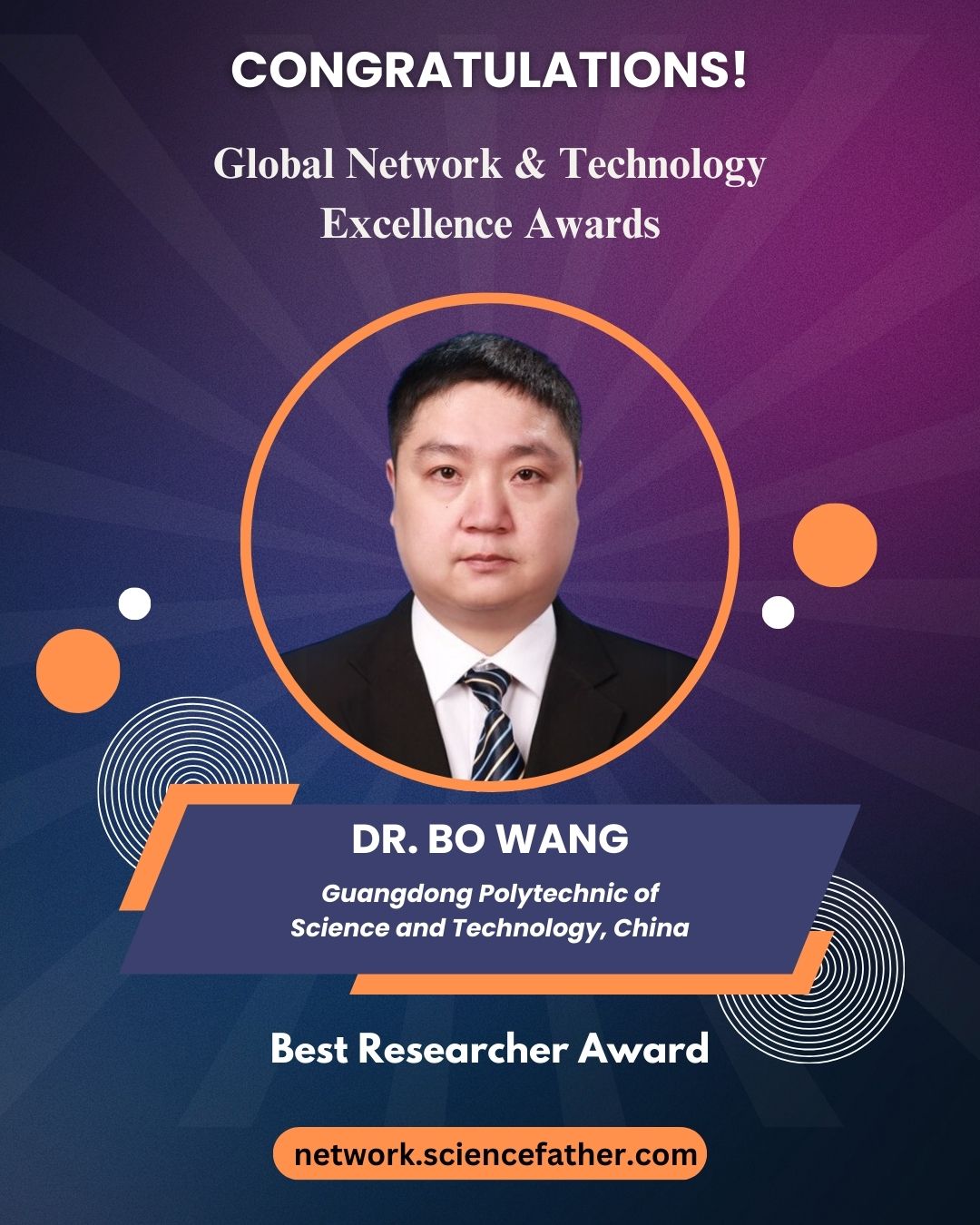
Dr. Bo Wang | Image Computing | Best Researcher Award #ScienceFather #Researcher #ResearchScientist #NetworkAwards #Researchawards #NetworkingEvent


Dr. Bo Wang, Guangdong Polytechnic of Science and Technology, He is from China, He won the Best Researcher Award in the event of Global Network & Technology Excellence Awards by ScienceFather.

Dr. Bo Wang is an Associate Professor specializing in artificial intelligence and electronic information technology. He earned his Ph.D. in Computer Application Technology from Harbin Engineering University in 2012 and has since built a distinguished career in academia and research. Dr. Wang has held key academic positions at Guangdong Polytechnic of Science and Technology and Harbin University of Science and Technology. 

His research spans artificial intelligence, electronic information systems, and molecular imaging. A prolific researcher, he has led numerous funded projects and published extensively in high-impact journals. His work has significantly contributed to advancing intelligent systems and innovative applications, earning him recognition as a leading expert in his field.

Dr. Wang’s exceptional contributions to artificial intelligence and electronic information technology make him a strong candidate for the Best Researcher Award. His leadership in funded research projects, including those in Guangdong Province and Heilongjiang, demonstrates his ability to address critical technological challenges. 

His interdisciplinary expertise and impactful publications have advanced the fields of AI and molecular imaging. Dr. Wang’s innovative work exemplifies excellence in research and reflects the award’s criteria for groundbreaking contributions to science and technology.

Best wishes for your future by ScienceFather

See more Info :  network.sciencefather.com


Social Media :


#ScienceFather #Researcher #ResearchScientist #Speaker #AI #Networking #NetworkAwards #ResearchAwards #NetworkingEvent #Innovation #TechAwards #AcademicExcellence #ArtificialIntelligence #DataScience #MachineLearning #CloudComputing #CyberSecurity #IoT #Blockchain #BigData #QuantumComputing #5G #SmartTechnology #ScientificBreakthrough #STEM #Entrepreneurship #TechNetworking #IndustryLeaders #GlobalRecognition #ResearchExcellence #TechnologyTrends


Saturday, March 1, 2025

Prof. Dr. Jivka Ovtcharova | Karlsruhe Institute of Technology | Germany #ScienceFather #Researcher #Researchawards #Networking #NetworkAwards


Prof. Dr. Jivka Ovtcharova, Karlsruhe Institute of Technology, She is from Germany, She won the Outstanding Scientist Award in the event of Global Network & Technology Excellence Awards by ScienceFather.

Prof. Dr. Jivka Ovtcharova is a pioneering professor at the Karlsruhe Institute of Technology (KIT) and a leading expert in intelligent systems and production engineering. As the first female professor at KIT’s Faculty of Mechanical Engineering and the first director of the FZI Research Center for Information Technology, she bridges engineering and computer science. 

Her work focuses on integrating AI, virtual reality, and human-machine interaction to drive digital transformation. Prof. Ovtcharova is a celebrated keynote speaker, author, and board member, recognized globally for her contributions to technology and innovation.

Best wishes for your future by ScienceFather


Social Media :


#ScienceFather #Researcher #ResearchScientist #Speaker #AI #Networking #NetworkAwards #Researchawards #NetworkingEvent #NetworkAwards #Networking #NetworkingEvent #NetworkTechnology #CyberSecurity #CloudComputing #5G #IoT #AI #DataSecurity #WirelessNetworking #EdgeComputing

Thursday, February 27, 2025

Prof. Jianyong Zuo | Tongji University | China | Best Researcher Award #ScienceFather #Researcher #ResearchScientist #NetworkAwards #Networkingevent


Prof. Jianyong Zuo, Tongji University, He is from China, He won the Best Researcher Award in the event of Global Network & Technology Excellence Awards by ScienceFather.

Jianyong Zuo is a distinguished Professor and Doctoral Supervisor at Tongji University, specializing in Rail Vehicles and Brake Control. He holds several leadership roles, including Associate Dean of the College of Transportation and Executive Associate Dean of the Institute of Rail Transit.

With a Ph.D. from Shanghai Jiaotong University, his research spans multiple areas of transportation engineering, particularly in high-speed trains and braking systems. Zuo has received numerous accolades and has published extensively in top engineering journals.

His work significantly contributes to the development of efficient and sustainable rail transport systems.

Best wishes for your future by ScienceFather


Social Media :


#ScienceFather #Researcher #ResearchScientist #Speaker #AI #Networking #NetworkAwards #ScienceFather #Researchawards #NetworkingEvent #NetworkAwards #Networking #NetworkingEvent #NetworkTechnology #CyberSecurity #CloudComputing #5G #IoT #AI #DataSecurity #WirelessNetworking #EdgeComputing


Wednesday, February 26, 2025

Network Technology Trends for 2025: #ScienceFather #Researcher #ResearchScientist #Blockchain #CyberSecurity #IoT #AI #Networking


The rapid evolution of network technology is shaping the future of digital connectivity. In 2025, several key trends will drive innovation and transformation in networking, ensuring faster, more secure, and energy-efficient communication systems.

Top Network Technology Trends for 2025:

  1. 6G Development – The successor to 5G will offer ultra-fast speeds, lower latency, and AI-driven optimization.
  2. AI-Driven Networking – AI-powered network automation and predictive analytics will enhance efficiency, security, and fault detection.
  3. Quantum Networking – Advancements in quantum computing will introduce ultra-secure communication using quantum cryptography.
  4. Network Slicing in 5G/6G – Enables customized network partitions for different applications, optimizing speed and reliability.
  5. Edge Computing Expansion – More processing will shift to edge nodes to reduce latency and enhance real-time applications.
  6. Energy-Efficient Networking – Sustainability-focused innovations, like AI-powered energy management and green data centers, will gain traction.
  7. IoT and Smart Connectivity – Massive IoT deployments will require highly scalable and low-power network solutions.
  8. Wi-Fi 7 Adoption – Next-gen Wi-Fi technology will deliver multi-gigabit speeds and improved connectivity in dense environments.
  9. Blockchain for Network Security – Decentralized security solutions will improve data integrity and reduce cyber threats.
  10. Autonomous Networks – Self-optimizing, self-healing networks will become a reality, reducing the need for manual intervention.

These trends will drive the future of networking, ensuring smarter, faster, and more secure communication across industries. 🚀


Social Media :


#ScienceFather #Researcher #ResearchScientist #Speaker #AI #Networking #NetworkAwards #ScienceFather #Researchawards #NetworkingEvent #NetworkAwards #Networking #NetworkTechnology #6G #QuantumNetworking #AI #EdgeComputing #NetworkSecurity #Blockchain #CyberSecurity #IoT #WiFi7 #CloudComputing #DataPrivacy #GreenNetworking #SmartCities #AutonomousNetworks #NetworkSlicing #EnergyEfficiency #SatelliteInternet #NextGenNetworking #FutureOfTech

Sunday, February 23, 2025

Energy-Efficient Networking: #ScienceFather #Researchawards #NetworkAwards #EnergyEfficientNetworking #GreenIT


Energy-efficient networking focuses on minimizing power consumption while maintaining optimal network performance and connectivity. As digital infrastructure expands, the demand for sustainable and eco-friendly networking solutions has increased, driving innovations in hardware, software, and protocols that reduce energy usage.

Key Aspects of Energy-Efficient Networking:

  • Green Data Centers: Use renewable energy sources, efficient cooling systems, and AI-driven optimization to reduce power consumption.
  • Energy-Aware Protocols: Implement power-saving mechanisms such as Energy-Efficient Ethernet (EEE) and adaptive transmission techniques.
  • Network Virtualization: Software-defined networking (SDN) and network function virtualization (NFV) optimize resource allocation, reducing redundant hardware usage.
  • IoT and Edge Computing: Distribute processing closer to the data source, minimizing energy-intensive data transmission to central cloud servers.
  • Smart Sleep Modes: Enable network devices to enter low-power states when not actively transmitting data.


Social Media :


#ScienceFather #Researcher #ResearchScientist #Speaker #AI #Networking #NetworkAwards #ScienceFather #Researchawards #NetworkingEvent #NetworkAwards #Networking #EnergyEfficientNetworking #GreenIT #SustainableTech #SmartNetworking #LowPowerNetworking #GreenDataCenters #EnergyAwareProtocols #IoT #EdgeComputing #NetworkVirtualization #EcoFriendlyTech #CarbonFootprintReduction #AIinNetworking #EnergyEfficientEthernet


Wednesday, February 19, 2025

Cybersecurity Challenges in Modern Networks: #ScienceFather #Researcher #ResearchScientis #Networking #Cybersecurity


Modern networks, including enterprise infrastructures, IoT ecosystems, and cloud environments, face a wide array of cybersecurity challenges due to increasing complexity, evolving attack vectors, and growing interconnectivity. Some of the most pressing issues include:

1. Advanced Persistent Threats (APTs)

APTs involve prolonged and targeted cyberattacks by well-funded adversaries, such as nation-states or cybercriminal organizations. These attacks use sophisticated methods to infiltrate networks, steal sensitive data, and remain undetected for extended periods.

2. Ransomware and Malware Attacks

The rise of ransomware attacks has significantly impacted businesses and critical infrastructures. Attackers encrypt files and demand ransoms in cryptocurrencies. Malware, including trojans and worms, can spread across networks, disrupting operations.

3. Zero-Day Vulnerabilities

Hackers exploit unknown software vulnerabilities before they are patched. These zero-day attacks pose a major risk, as no immediate defense is available until security updates are developed and deployed.

4. IoT Security Risks

The proliferation of IoT devices has expanded the attack surface. Many IoT devices lack robust security mechanisms, making them vulnerable to exploitation, botnets (e.g., Mirai), and unauthorized access.

5. Cloud Security Challenges

Organizations increasingly rely on cloud services, but misconfigured cloud storage, insecure APIs, and weak authentication methods can expose sensitive data to cyber threats.

6. Insider Threats

Employees, contractors, or partners with access to internal systems can pose security risks, whether intentionally or due to negligence. Insider threats are harder to detect and prevent compared to external attacks.

7. Phishing and Social Engineering Attacks

Cybercriminals manipulate individuals through phishing emails, fraudulent websites, or impersonation attacks to steal credentials, deploy malware, or compromise networks.

8. Supply Chain Vulnerabilities

Attackers exploit vulnerabilities in third-party vendors, software providers, or hardware manufacturers to infiltrate an organization’s network. Supply chain attacks, such as the SolarWinds breach, highlight this growing threat.

9. 5G and Edge Computing Risks

The expansion of 5G networks and edge computing introduces new security risks, such as increased attack surfaces, decentralized data processing, and potential vulnerabilities in telecom infrastructure.

10. Compliance and Regulatory Challenges

Organizations must adhere to stringent cybersecurity regulations (e.g., GDPR, NIST, ISO 27001) and face penalties for non-compliance. Keeping up with evolving standards and data protection laws remains a challenge.

Mitigation Strategies

  • Zero Trust Architecture (ZTA): Implementing strict identity verification and least privilege access.
  • AI and Machine Learning in Cybersecurity: Enhancing threat detection through behavior analytics.
  • Regular Patching and Updates: Fixing vulnerabilities before exploitation.
  • Strong Authentication and Encryption: Using MFA and end-to-end encryption to protect sensitive data.
  • Security Awareness Training: Educating employees to recognize and prevent cyber threats.
As digital transformation continues, cybersecurity in modern networks must evolve to address these challenges through proactive defense mechanisms and strategic risk management.


Social Media :


#ScienceFather #Researcher #ResearchScientist #Speaker #AI #Networking #NetworkAwards #ScienceFather #Researchawards #NetworkingEvent #NetworkAwards #Networking #ComputerNetwork #Networking #LAN #WAN #TCPIP #Internet #WiFi #5G #CyberSecurity #Cybersecurity #NetworkSecurity #DataProtection #Hacking #Ransomware #ZeroTrust #IoTSecurity #CloudSecurity #Phishing #CyberThreats #CyberDefense #Malware #Encryption #EthicalHacking #InsiderThreats #SupplyChainSecurity #5GSecurity #ThreatIntelligence #AIinCybersecurity #InfoSec


Monday, January 27, 2025

Evolution of Wireless Technology: From Wi-Fi to 6G #ScienceFather #ResearchScientist #Networking #NetworkAwards


Wireless technology has transformed the way we connect and communicate, evolving rapidly to meet the growing demand for faster speeds, higher capacity, and lower latency. Here's an overview of its progression from Wi-Fi to the emerging 6G era:

1. Wi-Fi (802.11 Standards): The Beginning of Wireless Internet

  • Introduced in the late 1990s, Wi-Fi enabled wireless local area networking (WLAN) for the first time.
  • Early Generations (802.11a/b/g): Provided basic connectivity with speeds up to 54 Mbps.
  • Advancements (802.11n/ac/ax): Delivered gigabit speeds, improved range, and better support for multiple devices.
  • Wi-Fi 6 (802.11ax) and Wi-Fi 6E expanded into the 6 GHz spectrum, increasing capacity and reducing interference.

2. 3G and 4G: Laying the Foundation for Mobile Broadband

  • 3G: Introduced mobile internet with speeds up to 2 Mbps, supporting basic browsing and multimedia.
  • 4G LTE: Revolutionized mobile connectivity with speeds up to 1 Gbps, enabling high-quality video streaming, online gaming, and seamless app experiences.

3. 5G: The Game Changer

  • Launched in the late 2010s, 5G represents a leap in wireless technology, offering speeds up to 10 Gbps and latency as low as 1 millisecond.
  • Key features include massive device connectivity, support for IoT, and critical applications like autonomous vehicles and remote surgery.

4. The Promise of 6G: A Glimpse into the Future

  • Expected by 2030, 6G aims to push the boundaries of wireless communication with:
    • Speeds: Up to 1 terabit per second (Tbps).
    • Latency: Ultra-low latency in the microsecond range.
    • AI Integration: Networks powered by artificial intelligence for self-optimization.
    • Terahertz Spectrum: Exploiting frequencies above 100 GHz for unprecedented data rates.
    • Applications: Holographic communication, real-time digital twins, and enhanced immersive experiences (e.g., VR/AR).

Impact of Wireless Technology Evolution

  • Empowered industries such as healthcare, manufacturing, transportation, and education.
  • Bridged the digital divide by providing connectivity in remote and underserved regions.
  • Paved the way for innovations like IoT, smart cities, and edge computing.


Social Media :


#ScienceFather #Researcher #ResearchScientist #Speaker #AI #Networking #NetworkAwards #NetworkTechnology #Technology #NetworkConference #WirelessTechnology #WiFi #3G #4G #5G #6G #MobileConnectivity #Networking #IoT #SmartCities #AIInNetworking #HolographicCommunication #LowLatency #HighSpeedInternet #DigitalTransformation #NextGenNetworks #FutureOfWireless #EmergingTechnologies #NetworkEvolution #TelecommunicationTrends #VRAR #EdgeComputing #NetworkingInnovation #UltraFastNetworks #TechEvolution


Tuesday, December 10, 2024

Global Networks: Backbone of Modern Connectivity:


A Global Network refers to a worldwide interconnected system of networks and devices that facilitate communication, data sharing, and resource access across geographical and cultural boundaries. It encompasses both physical infrastructure and software technologies, enabling seamless interaction and exchange of information across various domains.

Key Components of a Global Network:

  1. Infrastructure:

    • Fiber Optic Cables: High-speed data transmission via undersea and terrestrial cables.
    • Satellites: Provide connectivity in remote or underserved areas.
    • Cellular Networks: Mobile communication through technologies like 4G, 5G, and beyond.
    • Data Centers: Centralized hubs for storing and processing data.
  2. Protocols and Standards:

    • IP (Internet Protocol): Ensures devices can communicate over the internet.
    • TCP/IP: Protocol suite enabling reliable data transmission.
    • DNS (Domain Name System): Translates domain names to IP addresses.
  3. Technologies:

    • Cloud Computing: Offers scalable storage and computing power.
    • IoT (Internet of Things): Connects everyday devices to the internet for smart functionalities.
    • Blockchain: Provides decentralized and secure transaction systems.
    • Artificial Intelligence (AI): Enhances decision-making and automation.
  4. Applications:

    • Social Media Platforms: Facilitate global communication and collaboration.
    • E-commerce Systems: Enable international trade and transactions.
    • Telecommunication: Voice, video, and text communication across borders.
    • Streaming Services: Deliver content like video, audio, and live broadcasts globally.
  5. Cybersecurity:

    • Firewalls and Encryption: Protect data integrity and privacy.
    • Authentication Systems: Secure access through passwords, biometrics, and multi-factor authentication.
    • Incident Response: Manage and mitigate breaches.

Impact of Global Networks:

  1. Economic Growth: Promotes international trade, remote work, and global business collaboration.
  2. Education and Research: Facilitates access to resources, online learning platforms, and collaborative research.
  3. Cultural Exchange: Breaks barriers, fostering understanding through social media, entertainment, and virtual communities.
  4. Healthcare: Telemedicine and remote diagnostics improve access to medical services.

Challenges:

  • Digital Divide: Unequal access to technology and connectivity.
  • Cybersecurity Threats: Increased vulnerability to hacking, malware, and phishing attacks.
  • Regulation and Privacy: Balancing innovation with user privacy and ethical concerns.

Global networks are the backbone of modern society, powering innovation, connectivity, and growth while presenting new challenges to navigate.


Social Media :


#ScienceFather #Researcher #ResearchScientist #Speaker #Networkingevents #5GNetwork #AdHocNetworks #Decentralized #WirelessCommunication #TemporaryNetworks #PeerToPeer#TemporaryTeams #ProjectBased #Collaboration #FlexibleTeams #Networking #CloudNetwork #LAN #LocalAreaNetwork #WiredLAN #WirelessLAN #NetworkArchitecture #GlobalNetwork #Technology #Connectivity #Innovation #AI #IoT #5G #CloudComputing #DigitalFuture #Cybersecurity


Saturday, December 7, 2024

Exploring Key Aspects of Wireless Mobile Networking:


Wireless and mobile networking refers to technologies that enable devices to communicate and exchange data without physical connections, using radio waves or other electromagnetic methods. These technologies are integral to modern communication, allowing mobility, convenience, and connectivity in diverse environments. Key components and aspects include:

1. Wireless Technologies:

  • Wi-Fi (802.11 Standards): Local wireless networks enabling high-speed internet connectivity for devices like laptops, smartphones, and IoT gadgets within limited areas.
  • Bluetooth: Short-range communication technology ideal for connecting peripherals such as headphones, keyboards, and wearables.
  • Zigbee and NFC: Specialized for low-power IoT communication and secure, short-distance transactions.

2. Mobile Networking:

  • Cellular Networks: Systems like 3G, 4G LTE, and 5G facilitate communication across vast distances, supporting voice, video, and data services.
  • 5G Technology: Offers faster speeds, lower latency, and greater device connectivity, revolutionizing industries like healthcare, autonomous vehicles, and smart cities.

3. Infrastructure and Components:

  • Cell Towers and Base Stations: Essential for cellular communication, these structures transmit signals to and from mobile devices.
  • Satellite Communication: Enables global coverage, crucial for remote locations, GPS, and emergency services.
  • Access Points and Wireless Routers: Provide local wireless connectivity, bridging devices to larger networks.

4. Applications:

  • Internet of Things (IoT): Connects sensors, appliances, and other devices, enabling smart homes, smart cities, and industrial automation.
  • Mobile Applications: Supports services like streaming, e-commerce, and social media through mobile devices.
  • Edge Computing: Facilitates real-time data processing near the data source, enhancing performance for applications like AR/VR.

5. Security Challenges:

  • Encryption Protocols: Ensuring data privacy in wireless transmission.
  • Authentication Systems: Protecting networks from unauthorized access.
  • Threat Mitigation: Addressing risks like eavesdropping, spoofing, and interference.

6. Benefits:

  • Mobility and flexibility in communication
  • Cost-effective infrastructure compared to wired networks
  • Seamless integration into modern lifestyles and industrial processes


Social Media :


#ScienceFather #Researcher #ResearchScientist #Speaker #Networkingevents #5GNetwork #Networking #CloudNetwork #LAN #LocalAreaNetwork #WiredLAN #WirelessLAN #NetworkArchitecture #NetworkSecurity #Technology #WirelessNetworking #MobileNetworking #5GTechnology #IoT #WiFi #Bluetooth #CellularNetworks #MobileApps #TechInnovation #SmartCities #EdgeComputing #CyberSecurity #Connectivity